


(no subject)
So, way back in, um, August, ![[personal profile]](https://www.dreamwidth.org/img/silk/identity/user.png) skygiants posted about Armed Services Edition paperbacks that were printed in special editions for serving military in WWII, and I mentioned I owned one and said if I could ever figure out where it was shelved I would post pictures.
skygiants posted about Armed Services Edition paperbacks that were printed in special editions for serving military in WWII, and I mentioned I owned one and said if I could ever figure out where it was shelved I would post pictures.
Well, I didn't manage to find it until November, and by then I had quit Tumblr for self-defense, so my lazy method of using Tumblr as an image host wasn't happening. But DW just rolled out a gui for its image hosting! So, only six months later, here are the pictures!
The one I own is "An Almanac for Moderns", which is basically a book of 365 short essays about nature and science, to be read one a day for a year. So I was almost right when I said I thought it was a field guide, yet couldn't find it shelved with the field guides. It's pretty fun, actually, but I could never stick with one chapter a day. As you might guess for an edition that was meant to be small and was published during the WWII paper shortages, the pages are very thin and very delicate seventy years later. (And I still haven't figured out why the sideways binding; to me it makes it more difficult to read, although maybe when it was newer it meant you could lay it flat on a table to read more easily?)

Front cover, with a standard mass-market paperback for scale

Armed Services Edition blurb

Attempting to read it

And flat

List of other titles

Back cover
(There's a few more uploaded in my dw images, if you can figure out how to get there....)
As is visible in a couple of the photos, my book has a single staple reinforcing the binding, which is a large part of what makes it hard to read. I can't tell if this was part of the standard binding or it was added by a later owner. It doesn't seem to be a later addition? It's definitely not a standard staple - you would have needed a heavy-duty stapler and staples - and the binding isn't falling apart in such a way that it seems needed. So IDK unlessskygiants knows!
And while I am posting images of cool old books I own, if you have ever been to an American public school you are probably familiar with the idea of a "marble composition book." I don't know if you ever wondered why those were a thing, but I bought a couple of marble composition books about a year ago that had somebody's school exercises from the mid-19th century in them, and the covers were actually marbled! It does make sense, I guess, that "not quite the cheapest" notebooks in the past would have actually marbled covers, but that's so divorced from what we get today that it never even occurred to me.
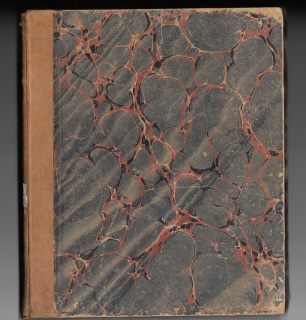


(the set of books I found also included an account books of day-to-day expenses in the late 19th century. Someday I am going to figure out where the dude was living and donate it to a historical society. They came with 0 provenance, so that didn't help.)
I am actually continuing to make substantial progress on the "sort all the books" project! I may start posting polls so you all can help me decide what to read off my long-unread fiction piles next - I am thinking "fuck, marry, kill" format where you get to decide if I have a sudden night of ill-considered passion, or continue my long-term relationship with having it in my bedroom, or get rid of it unread.
And finally, here is a picture of a cat:
skygiants posted about Armed Services Edition paperbacks that were printed in special editions for serving military in WWII, and I mentioned I owned one and said if I could ever figure out where it was shelved I would post pictures.Well, I didn't manage to find it until November, and by then I had quit Tumblr for self-defense, so my lazy method of using Tumblr as an image host wasn't happening. But DW just rolled out a gui for its image hosting! So, only six months later, here are the pictures!
The one I own is "An Almanac for Moderns", which is basically a book of 365 short essays about nature and science, to be read one a day for a year. So I was almost right when I said I thought it was a field guide, yet couldn't find it shelved with the field guides. It's pretty fun, actually, but I could never stick with one chapter a day. As you might guess for an edition that was meant to be small and was published during the WWII paper shortages, the pages are very thin and very delicate seventy years later. (And I still haven't figured out why the sideways binding; to me it makes it more difficult to read, although maybe when it was newer it meant you could lay it flat on a table to read more easily?)

Front cover, with a standard mass-market paperback for scale

Armed Services Edition blurb

Attempting to read it

And flat

List of other titles

Back cover
(There's a few more uploaded in my dw images, if you can figure out how to get there....)
As is visible in a couple of the photos, my book has a single staple reinforcing the binding, which is a large part of what makes it hard to read. I can't tell if this was part of the standard binding or it was added by a later owner. It doesn't seem to be a later addition? It's definitely not a standard staple - you would have needed a heavy-duty stapler and staples - and the binding isn't falling apart in such a way that it seems needed. So IDK unless
skygiants knows!And while I am posting images of cool old books I own, if you have ever been to an American public school you are probably familiar with the idea of a "marble composition book." I don't know if you ever wondered why those were a thing, but I bought a couple of marble composition books about a year ago that had somebody's school exercises from the mid-19th century in them, and the covers were actually marbled! It does make sense, I guess, that "not quite the cheapest" notebooks in the past would have actually marbled covers, but that's so divorced from what we get today that it never even occurred to me.


(the set of books I found also included an account books of day-to-day expenses in the late 19th century. Someday I am going to figure out where the dude was living and donate it to a historical society. They came with 0 provenance, so that didn't help.)
I am actually continuing to make substantial progress on the "sort all the books" project! I may start posting polls so you all can help me decide what to read off my long-unread fiction piles next - I am thinking "fuck, marry, kill" format where you get to decide if I have a sudden night of ill-considered passion, or continue my long-term relationship with having it in my bedroom, or get rid of it unread.
And finally, here is a picture of a cat:

no subject
no subject
The only thing I could think of is that somehow by putting the text in two columns per page, they were able to condense it more easily.
no subject
no subject
it's easier to read with columns in the long format but if they bind it the other way that wouldn't matter.
no subject
no subject
no subject
no subject
no subject
no subject
no subject
no subject
no subject
no subject
no subject
no subject
no subject
no subject
no subject
no subject
*purrs*
no subject
Of forty listed books:
Three are now considered classics, and widely available (Thurber, Thackeray, The Ox-Bow Incident); an additional one is now considered a great childrens' classic (The Yearling). Four authors are, I think, at the level of household name (Thurber, Twain, Whitman, Thackeray), and another several are people one is likely to have heard of if one is interested in their genre (Saroyan, Philip Wylie, Erle Stanley Gardner, Algernon Blackwood).
One is by an author who is a household name but not remotely for this, Ludwig Bemelmans, whom I had not known wrote for adults.
Two I have randomly heard of somewhere but cannot place at all when, where, or why: Young Man with a Horn and Bromfield's The Farm.
And two absolutely shock me, because nowadays they are hard to find, expensive, and sought out only by those who delve deeply into the author's genre, so that I am amazed they were ever issued as widely as they apparently were, and wonder what happened between then and now to cause them to drop out of sight: Elizabeth Goudge's Green Dolphin Street and Thorne Smith's The Night Life of the Gods. (I suppose I had known the Goudge was well-known enough for MGM to make a movie, but that still confuses me, too.)
Actually a pretty good hit ratio for books that are still relevant seventy-odd years later!
no subject
I would probably put Frank Sullivan and Frank Gruber on the "you've heard of them if you know the genre" list, too - Sullivan was in the vicinity of the Algonquian Round Table and I don't know if anyone still *reads* Gruber but if you're into the history of pulps (or Westerns) you can't avoid having heard the name.
Actually, even Peattie isn't that obscure as natural history writers go; I have two of his other books on my "nature books" shelf already and there was a major reprint of his stuff a few years ago.
I suspect they picked books based on a) it's old enough that the publisher will let us have the rights but b) it's still new and popular enough to interest young men. Which probably isn't a bad way to find stuff that will still be relevant decades later!
no subject
no subject
no subject
no subject
Also all of the old 19th century Icelandic diaries I've been looking at have marbled covers.
no subject
no subject
no subject