
![[personal profile]](https://www.dreamwidth.org/img/silk/identity/user.png)


(if I never get back)
Tonight we went to see the local AA baseball team play!
My family is loyal to the minor leagues, because we maintain that they're far more interesting to watch than the major leagues.
For example, in your average major league game, you're not too likely to see any of the following (much less all of them):
1. A run on four walks in a row
2. The entire audience on their feet cheering whenever the pitcher managed to throw a strike
3. 2 runs on a single fielding error
4. A ten-year-old as the main announcer
5. A bat, not just breaking but splintering, so hard that half of it ended up in the the outfield
6. A grounder down the first-base line being fumbled by the first baseman and bouncing foul, giving up a triple and a run
7. A live high school marching band and step squad
8. Three separate innings ending with bases loaded, full count, and two outs
9. More pitchers than innings
10. A foul into the stands, which landed so far away from where anyone was sitting that the 'crowd' had to goad the nearest person into going down and fishing it out from under the bleachers. (Okay, you might see that one at an O's game, but only in a particularly bad year.)
11. Little leaguers shadowing the pros on the field
12. Third base stolen on a ball. Twice.
13. A runner taking three bases - including home - due to the catcher repeatedly dropping the ball.
14. A live breakdancing contest between four twelve-year-olds to the tune of "Cotton-Eye Joe"
//this section of the post brought to you by all the cricket discussion I have been subjected to by Andy Zaltzmann on the Bugle. (If any non-Americans would like an explanation for any of the above, you are welcome to ask... except the break-dancing, I have no explanation for that.)
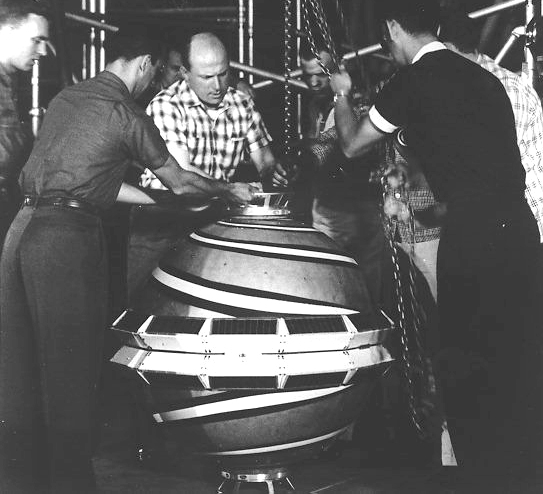
We also went to the National Electronics Museum, which was a lot more fun than I expected it to be, even if I'm still not sure I understand electrical potential. (It's possible I do understand it and it's just a very mushy concept. It may be time to pull out Physics for Poets again.) It's one of those old-fashioned museums that mostly an excuse for displaying an excellent collection of Stuff: there's everything from telegraph keys to an Enigma machine to a chronological display of vacuum tubes to an early microwave oven to a WWII communications truck, plus a lot of space program and aviation stuff (TRANSIT satellites? Look even more like UFOs in real life.) No Tesla coil though. It made me really want to write some good meaty scientifiction, while at the same time pointing up just how difficult it is for SF writers to keep up with current tech, much less predict the future. (Also, infrared mirrors=awesome.)
My family is loyal to the minor leagues, because we maintain that they're far more interesting to watch than the major leagues.
For example, in your average major league game, you're not too likely to see any of the following (much less all of them):
1. A run on four walks in a row
2. The entire audience on their feet cheering whenever the pitcher managed to throw a strike
3. 2 runs on a single fielding error
4. A ten-year-old as the main announcer
5. A bat, not just breaking but splintering, so hard that half of it ended up in the the outfield
6. A grounder down the first-base line being fumbled by the first baseman and bouncing foul, giving up a triple and a run
7. A live high school marching band and step squad
8. Three separate innings ending with bases loaded, full count, and two outs
9. More pitchers than innings
10. A foul into the stands, which landed so far away from where anyone was sitting that the 'crowd' had to goad the nearest person into going down and fishing it out from under the bleachers. (Okay, you might see that one at an O's game, but only in a particularly bad year.)
11. Little leaguers shadowing the pros on the field
12. Third base stolen on a ball. Twice.
13. A runner taking three bases - including home - due to the catcher repeatedly dropping the ball.
14. A live breakdancing contest between four twelve-year-olds to the tune of "Cotton-Eye Joe"
//this section of the post brought to you by all the cricket discussion I have been subjected to by Andy Zaltzmann on the Bugle. (If any non-Americans would like an explanation for any of the above, you are welcome to ask... except the break-dancing, I have no explanation for that.)
We also went to the National Electronics Museum, which was a lot more fun than I expected it to be, even if I'm still not sure I understand electrical potential. (It's possible I do understand it and it's just a very mushy concept. It may be time to pull out Physics for Poets again.) It's one of those old-fashioned museums that mostly an excuse for displaying an excellent collection of Stuff: there's everything from telegraph keys to an Enigma machine to a chronological display of vacuum tubes to an early microwave oven to a WWII communications truck, plus a lot of space program and aviation stuff (TRANSIT satellites? Look even more like UFOs in real life.) No Tesla coil though. It made me really want to write some good meaty scientifiction, while at the same time pointing up just how difficult it is for SF writers to keep up with current tech, much less predict the future. (Also, infrared mirrors=awesome.)
no subject
no subject
no subject
no subject
Thoughts
Re: Thoughts
no subject
no subject
no subject
That said, what makes the electrons want to move falls into three basic categories: electrostatic repulsion, electronegativity, and magnetism. (Overcrowding, LOCATION LOCATION LOCATION, and forced resettlement.)
Sometimes emf (aka voltage or potential) is generated because a lot of electrons are pushed into a place where there aren't enough atoms for them to all live in. If provided a convenient path where there are homes (or even just less overcrowding), excess electrons will tend to take that path. (Capacitors work like this.)
Sometimes emf is generated by chemical properties. If the flow of electrons can, by electrochemical reactions, cause a net decrease in the chemical potential energy in disparate substances, the electrons will be motivated to take that path. (Batteries work like this.)
Sometimes emf is generated by a conductor with loosely bound electrons and a magnetic field moving in relation to each other. Because of the rather close relationship between electricity and magnetism, electric fields and magnetic fields interact with each other in such a way that when a field of one kind is moving, it creates a field of the other kind. This causes things that already have their own static field of the other kind to tend to move. (Generators work like this. And motors, which are really just generators operated backwards.)
Caveat, of course, is that this is all top-of-my-head from when I used to do this, some 20 years ago. I'm not all that confident my explanation of batteries makes that much sense. ;) But if you like, I can take the time to reacquaint myself with the material and spend some time writing better (or at least different) answers.
no subject
"Why is it so much more complicated than gravitational potential energy?" is the million dollar question, at least in forms like "Why is the electromagnetic force attractive/repulsive and the gravitic force (apparently) only attractive?" If you knew the answer, you'd be in line for a Nobel Prize in physics and a million bucks.
no subject
There are things that I appreciate about minor league baseball, with cheap seats with great views being top of the list, but I don't find the same charm you seem to in the mental mistakes the players make. Double A is as low as I'm willing to go (and in my experience AA ball is a lot higher quality than what you suggest you saw). That sounds more like my experience watching rookie league play.
no subject
I think the quality of AA depends considerably on how good the teams above are - this being an Orioles farm team, lately any halfway decent player has gotten pulled up the minute they show a single gleam of competence. One of the 2011 O's starting pitchers was on the AA team last year. (Also this was an unusually excitement-filled game: generally three or four fascinating mistakes happen, not more errors than hits... I think the lighting was particularly bad, among other things it was clear the first-basemen couldn't see the field half the time.)
no subject
no subject
Cosigned. ;) (Not an engineer, but learned all my electricity & electronics from the standpoint of understanding the engineering, rather than undestanding the science.)
no subject
The other (possibly good, possibly awkward) thing I've noticed at minor league games is that the players are often close enough to hear you when you heckle.
no subject